
Predictive Engineering³ - Code, Surveillance, and Collaboration
Brining Julia Scher’s Surveillance Installation to life for SFMOMA

In 2016, I had the unique opportunity to serve as a collaborative designer and developer for Predictive Engineering³, the reimagined installation by artist Julia Scher at SFMOMA. The piece was commissioned for the opening of the newly built SFMoMA. The work itself is part sculpture, part surveillance system, part recursive time machine, an evolving media installation that interrogates power, control, and the architecture of watching. It was originally conceived in 1993 and reinstalled in 1998, but this latest version demanded a complete technological reinvention. My job was to translate a deeply conceptual, multi-decade artwork into something technically coherent and experientially charged in a contemporary museum setting.
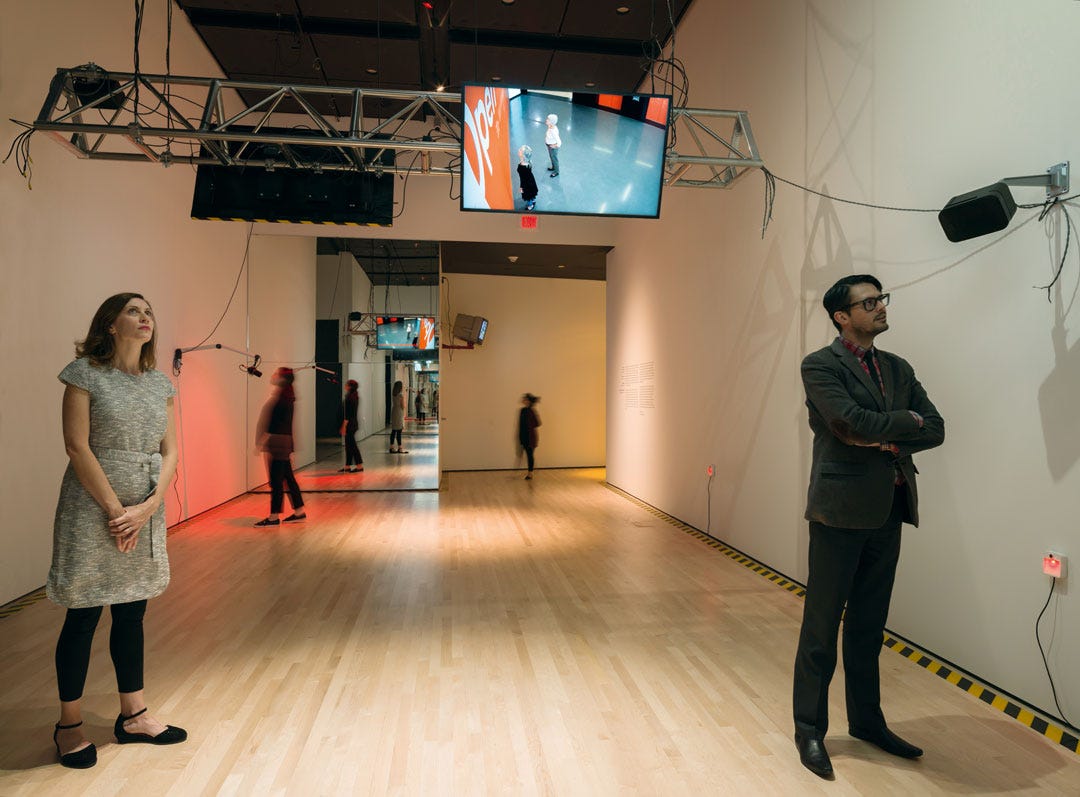
Julia and I collaborated remotely for nearly a year, across time zones, across disciplines, and often across languages of intent. She would describe moods and concepts, metaphors and feelings. I would interpret those into camera placement schematics, data routing diagrams, and custom-built software. After 11 months of digital collaboration, we meet in person to bring the physical space to life. This was not a typical artist-technologist relationship; it was a living, breathing negotiation between vision and feasibility, aesthetics and circuitry. We didn’t just build a system—we co-composed an environment.

The technical framework was complex. We installed live surveillance cameras throughout SFMOMA’s architecture, fed that footage into a series of distorted video loops, then embedded the results into mirrored displays and custom media panels that mimicked institutional signage. I built a modular software backbone that could shift in real-time between live feeds and archival glitch footage, allowing the piece to feel constantly in flux, just like surveillance itself. There was no clear beginning or end. The system monitored, responded, and reinvented itself.
One of the most challenging aspects was honoring the conceptual DNA of the previous two versions while engineering a platform that could support future iterations. Julia often talks about Predictive Engineering as an “episodic, self-consuming” artwork; it eats itself over time. That meant we couldn’t simply restore the old work; we had to build something that contained echoes of the past while responding to the now. The result is an environment that implicates you the moment you enter it. You see yourself reflected and refracted. You hear voices, sometimes yours, sometimes others. You don’t quite know where the watching begins. It’s a portrait of institutional power rendered in cables, software, and surveillance feeds.
Working on Predictive Engineering³ pushed me to think differently about collaboration, authorship, and longevity in media art. It wasn’t just about making things work; it was about making them haunt. And it reminded me that some of the most powerful systems we build are the ones that quietly watch us back.